Taste the Changing Fields
Edible data story · Ukraine Now, Dartmouth · 2026
Role · Artist, Data Visualization
In 2024 a honey was made in Ukraine from fields no one could walk into. The land was farmland near the Russian border, mined and under shelling. It belongs to Kernel, Ukraine’s largest producer and exporter of sunflower oil. Drones sowed it with phacelia, a blue-flowered plant that bees love and that grows in poor, dry ground. Twenty hives stood at the safe edge. The bees were the only workers who could bring in the harvest: 200 kilograms, sold as Minefield Honey. It sold out, and no jar can be found. What is left of its taste is one sentence from a German laboratory: “aromatic, medicinal, slightly fruity.”
This artwork treats that missing taste as a mystery to be worked out from evidence. A jar of honey is a record of what the bees could reach that year, so the question “what did it taste like there?” is also the question “what was growing there, and why?” The sunflower is Ukraine’s flower and its great honey plant. In the two border regions where the honey was planned, Chernihiv and Sumy, farmers sowed sunflower in the spring of 2022 on land Russian troops had left only days before, with mines already in the fields. Sunflower was the crop they held on to: the one that pays best, that is pressed into oil inside Ukraine, and that does not need costly gas to dry it, as corn does. Then it thinned. By 2024, the honey’s year, Chernihiv had lost a third of its 2022 sunflower and Sumy nearly half. Phacelia arrived from the air on seventeen hectares of the ground that could no longer be worked. On November 12, 2026, five days before this work was first shown, Kernel announced it had suspended all eight of its oil plants after Russian strikes.
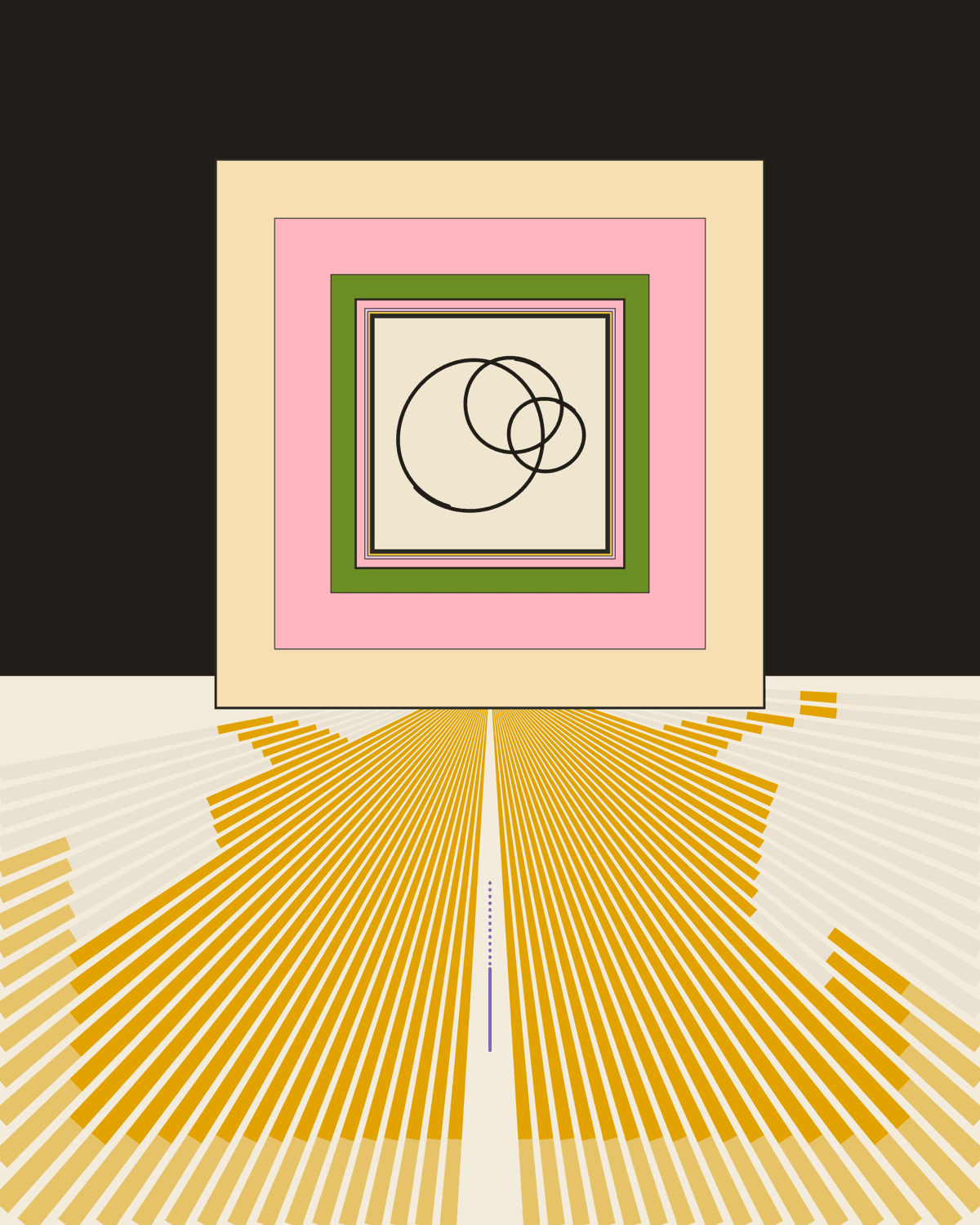
The print is read from the horizon toward the viewer. Each cut row in the field is ten thousand hectares of sunflower, Chernihiv on the left and Sumy on the right, running from 2021 at the horizon to 2026 at our feet. A gold row was sown that year; a bare furrow is sunflower land gone quiet. The palest rows, nearest us, are 2026, still an estimate. Down the centre runs a single thin line, the phacelia: dotted in 2023, when a first test sowing fell short in drought, and whole in 2024. At true scale it would be about six hundred times thinner than one row.
In front of the field stands the dish, drawn as a nested square with every frame true to area: a sweet-cream gelato, and inside it, in thin frames, the honey. The middle of the square is left empty, because the honey is not here. In that space, hand-drawn circles hold our best estimate of it: one circle for each plant the bees most likely fed on, phacelia first, then sunflower and linden, each sized by its share. Where the circles overlap is the taste the plants share. It is a guess, and it is drawn as one.
Interactive edible installation: Ukrainian sunflower (two regions), acacia, linden and buckwheat honeys, nearest zone Polish phacelia honey, and the blended reconstruction. Presented at Ukraine Now, Baker-Berry Library, Dartmouth College, November 17, 2026.